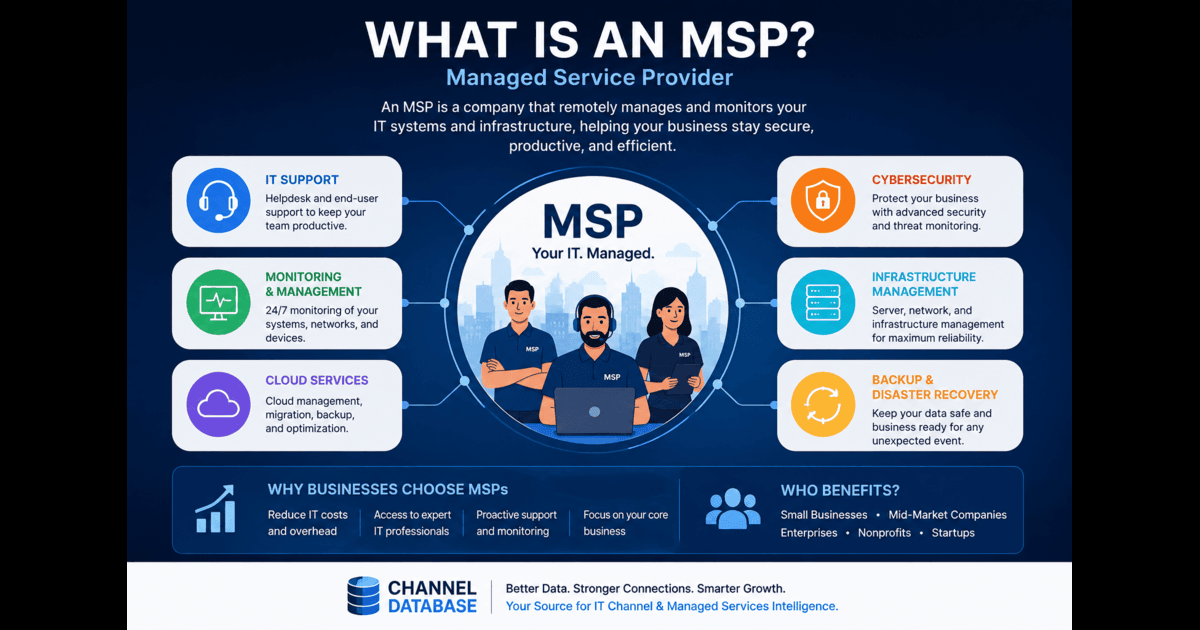
A Managed Service Provider (MSP) is a company that remotely or proactively manages technology services for another organization.
Instead of waiting for an IT problem to occur, an MSP typically monitors systems, manages infrastructure, provides technical support, maintains security controls, and helps keep business technology operating reliably.
MSPs can support small businesses, mid-market organizations, enterprises, healthcare providers, financial companies, professional services firms, and many other industries.
What does MSP stand for?
MSP stands for Managed Service Provider. An MSP is a technology company that manages IT services, systems, infrastructure, applications, security, or other technology functions on behalf of customers, often under an ongoing service agreement or recurring subscription.
What Does an MSP Do?
The services provided by an MSP depend on its capabilities, customer base, technology partnerships, and specialization. However, most MSPs focus on managing technology proactively and providing ongoing support.
IT Helpdesk & Support
Remote technical support, troubleshooting, user assistance, ticket management, and end-user support.
Network Management
Monitoring and management of networks, routers, switches, firewalls, connectivity, and network infrastructure.
Cloud Management
Management of cloud environments, Microsoft 365, Azure, AWS, Google Workspace, backup, storage, and cloud infrastructure.
Cybersecurity
Security monitoring, endpoint protection, identity management, vulnerability management, backup, and other security services.
Backup & Disaster Recovery
Data backup, recovery planning, business continuity, and disaster recovery services.
IT Infrastructure
Server management, infrastructure monitoring, virtualization, systems administration, and technology lifecycle management.
How Is an MSP Different From Traditional IT Support?
Traditional IT support has historically focused on responding to problems when they occur. Managed services generally take a more proactive approach.
- • Often reactive
- • Problems trigger support
- • May use hourly billing
- • Limited ongoing monitoring
- • Focus can be incident-driven
- ✓ Proactive monitoring
- ✓ Ongoing management
- ✓ Recurring service model
- ✓ Preventive maintenance
- ✓ Strategic technology support
Types of Managed Service Providers
Not every MSP provides the same services. Some are generalist providers, while others specialize in particular technologies, industries, or service categories.
General Managed IT Service Providers
These providers manage a broad range of IT functions, including helpdesk, infrastructure, networking, endpoints, cloud, backup, and technology support.
Cloud MSPs
Cloud-focused MSPs specialize in cloud infrastructure, migration, cloud operations, optimization, Microsoft environments, AWS, Azure, and other cloud technologies.
Security-Focused MSPs
These providers combine managed IT services with stronger cybersecurity capabilities. Some evolve into or operate as Managed Security Service Providers, commonly known as MSSPs.
Industry-Specialized MSPs
Some MSPs focus on specific industries such as healthcare, financial services, legal services, manufacturing, education, or professional services.
Common MSP Services
The managed services market covers a broad range of IT capabilities. Common MSP service categories include:
Why Do Businesses Use MSPs?
Businesses often work with MSPs because managing modern IT infrastructure requires specialized skills, tools, security practices, and continuous monitoring.
Access to Expertise
MSPs provide access to teams with experience across multiple technologies and IT environments.
Proactive Management
Monitoring and preventive maintenance can help identify potential issues before they become larger problems.
Predictable IT Costs
Many MSPs use recurring service agreements that can make IT costs easier to plan and budget.
Scalability
Organizations can expand or adjust technology services as their workforce, infrastructure, and business requirements change.
How Does the MSP Business Model Work?
Many MSPs operate using recurring service agreements. Instead of charging customers only when something goes wrong, the MSP may provide a defined set of managed services for a recurring monthly or annual fee.
Assess
Understand the customer's technology environment.
Manage
Monitor and manage agreed IT services.
Monitor
Continuously monitor systems and performance.
Improve
Recommend improvements as business needs evolve.
How to Find the Right MSP
Choosing an MSP should involve more than comparing prices. Organizations should evaluate the provider's capabilities, experience, service coverage, security practices, technology partnerships, support model, and ability to meet their specific requirements.
Questions to Ask an MSP
- ✓ Which IT services are included in your managed service?
- ✓ What technologies and platforms do you support?
- ✓ Do you provide 24/7 monitoring or support?
- ✓ What cybersecurity services are included?
- ✓ Which cloud platforms do you specialize in?
- ✓ What industries do you typically serve?
- ✓ How do you measure service performance?
- ✓ What happens when a critical incident occurs?
Understanding the MSP Market Through Better Data
For technology vendors, distributors, consultants, investors, and channel teams, understanding the MSP market requires structured information about the companies operating within it.
Channel Database focuses on IT channel and managed services intelligence, helping organizations identify MSPs based on geography, services, technologies, company characteristics, partnerships, and professional contacts.
Explore MSP Data →Frequently Asked Questions About MSPs
What does MSP stand for?
MSP stands for Managed Service Provider. An MSP manages technology services or infrastructure for customers, typically on an ongoing basis.
What services do MSPs provide?
MSP services can include IT helpdesk, network management, cloud management, cybersecurity, backup, disaster recovery, endpoint management, infrastructure management, and IT consulting.
What is the difference between an MSP and an MSSP?
An MSP generally focuses on broader managed IT services, while an MSSP, or Managed Security Service Provider, focuses primarily on cybersecurity and security operations. Some providers offer both managed IT and managed security services.
Do small businesses use MSPs?
Yes. Small businesses commonly use MSPs to access IT expertise, technical support, monitoring, cybersecurity, and infrastructure management without building a large internal IT team.
How do MSPs charge customers?
Many MSPs use recurring monthly or annual service agreements. Pricing can depend on the number of users, devices, services, locations, technologies, and support requirements.
The Role of MSPs in Modern IT
Managed Service Providers have become an important part of the modern technology ecosystem. By combining technical expertise, proactive monitoring, support, security, cloud services, and infrastructure management, MSPs help organizations operate their technology more effectively.
As businesses continue adopting cloud platforms, cybersecurity technologies, remote work solutions, automation, and increasingly complex IT environments, the role of MSPs is likely to remain important across industries and markets.
For technology companies and channel organizations, understanding the MSP landscape is equally important for identifying partners, opportunities, and emerging markets.
Looking for MSP companies and decision-makers?
Explore structured MSP and IT channel intelligence designed for technology vendors, sales teams, consultants, market researchers, distributors, and channel professionals.
Managed Service Providers and the IT Channel
Managed Service Providers are a central part of the global IT services ecosystem. They help businesses manage infrastructure, networks, endpoints, cloud environments, cybersecurity, applications, and technical support.
For technology vendors, distributors, software companies, and channel organizations, understanding the MSP market can provide valuable insight into potential partnerships and routes to market.
Channel Database provides structured IT Channel and Managed Services intelligence to help organizations research MSPs, identify relevant companies, understand their capabilities, and connect with appropriate business contacts.