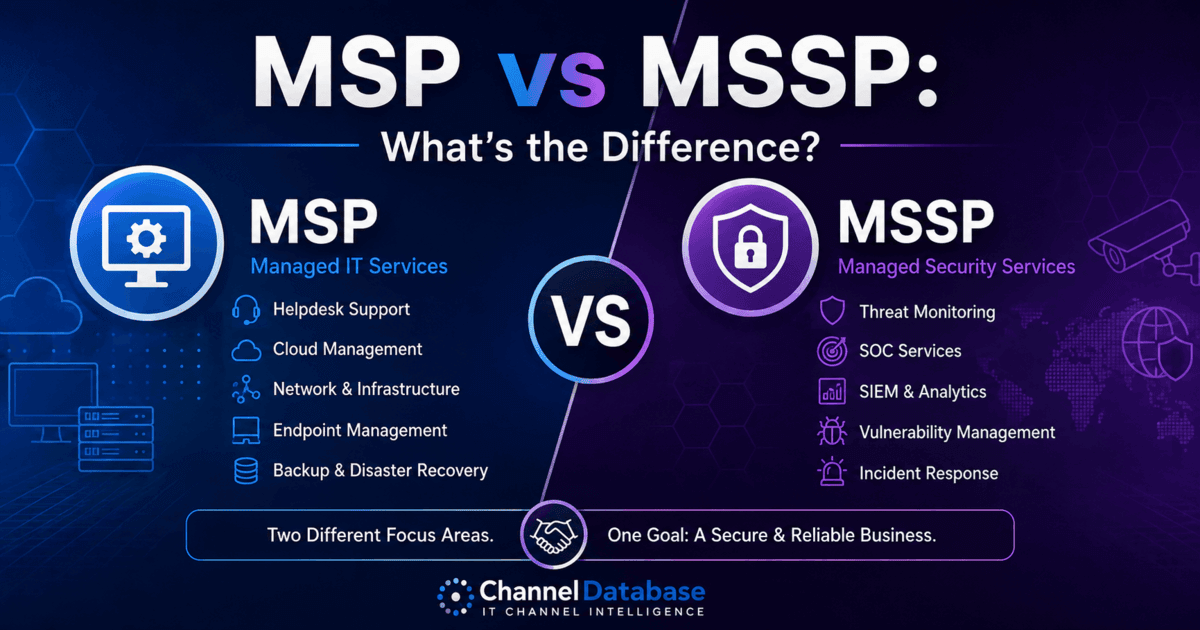
MSP vs MSSP: What's the Difference?
Understand the difference between Managed Service Providers and Managed Security Service Providers, the services they offer, and when a business may need an MSP, MSSP, or both.
Modern businesses depend on increasingly complex IT environments. Cloud platforms, remote work, connected devices, applications, networks, identities, and cybersecurity all need continuous management. MSPs and MSSPs help organizations address these requirements, but their areas of focus are different.
MSP
Managed IT
MSSP
Managed Security
MSP + MSSP
Complete IT & Security Coverage
What is the difference between an MSP and an MSSP?
An MSP, or Managed Service Provider, generally manages a broad range of IT services such as helpdesk support, networks, endpoints, infrastructure, cloud environments, and day-to-day IT operations.
An MSSP, or Managed Security Service Provider, focuses primarily on cybersecurity and security operations. MSSPs may provide threat monitoring, security operations center services, SIEM, managed detection and response, vulnerability management, incident response, identity security, and related security services.
The distinction is not always absolute. Some MSPs offer substantial cybersecurity services, while some MSSPs provide broader managed IT capabilities.
MSP vs MSSP at a Glance
The simplest way to understand the difference is to look at the primary problem each provider is designed to solve.
| Category | MSP | MSSP |
|---|---|---|
| Primary Focus | Managed IT operations | Managed cybersecurity |
| Helpdesk | Common | Usually secondary |
| Network Management | Common | Security-focused |
| Cloud Management | Common | Security and cloud protection |
| Security Monitoring | May be offered | Core capability |
| SOC Services | Sometimes | Common |
| SIEM / Security Analytics | May be offered | Common |
| Incident Response | Varies | Security-focused |
What Is an MSP?
An MSP is a Managed Service Provider. MSPs provide ongoing technology management and support for organizations that want to outsource some or all of their IT operations.
Instead of relying entirely on an internal IT team, a business may use an MSP to monitor systems, manage infrastructure, provide technical support, administer cloud services, manage endpoints, maintain networks, and perform other IT functions.
Typical MSP Services
- ✓ Managed IT support
- ✓ Helpdesk services
- ✓ Network management
- ✓ Server management
- ✓ Cloud management
- ✓ Endpoint management
- ✓ Backup and disaster recovery
- ✓ Microsoft 365 management
MSP's Main Objective
The primary objective of an MSP is generally to keep a customer's IT environment reliable, available, supported, and aligned with business requirements.
Think:
"Keep the IT environment running."
What Is an MSSP?
An MSSP is a Managed Security Service Provider. MSSPs specialize in managing cybersecurity operations and security controls on behalf of customers.
An MSSP may monitor security events, detect threats, investigate suspicious activity, manage security technologies, assist with incident response, and provide ongoing security operations.
Typical MSSP Services
- ✓ Security monitoring
- ✓ Security Operations Center services
- ✓ SIEM management
- ✓ Managed detection and response
- ✓ Threat detection
- ✓ Vulnerability management
- ✓ Security incident response
- ✓ Endpoint security
MSSP's Main Objective
The primary objective of an MSSP is generally to help customers identify, monitor, prevent, investigate, and respond to cybersecurity threats.
Think:
"Protect the IT environment."
MSP vs MSSP Services
There is considerable overlap between MSP and MSSP services. The difference is usually the depth and primary responsibility associated with cybersecurity.
Where MSPs and MSSPs Overlap
The line between MSPs and MSSPs is not always clear-cut. Technology environments have become increasingly connected, and cybersecurity is now part of almost every organization's IT strategy.
A mature MSP may offer managed endpoint security, firewall management, vulnerability scanning, identity services, backup, security awareness, and other security capabilities.
Likewise, an MSSP may manage security infrastructure that depends on cloud platforms, endpoints, networks, identities, and other IT systems.
The modern provider may be both
Many technology service providers position themselves as full-service managed technology partners, combining managed IT services with cybersecurity capabilities.
When Should a Business Choose an MSP?
An MSP may be appropriate when a business needs ongoing technology management but does not want to handle every IT function internally.
Limited Internal IT Resources
The organization needs additional IT expertise or operational capacity.
Growing Technology Environment
Infrastructure, users, cloud platforms, and applications are becoming harder to manage internally.
Need for 24/7 Monitoring
The organization needs ongoing infrastructure or endpoint monitoring beyond its internal operating hours.
Cloud & Infrastructure Management
The business needs assistance managing cloud, networking, servers, endpoints, or other infrastructure.
When Should a Business Choose an MSSP?
An MSSP may be appropriate when cybersecurity requires dedicated expertise, monitoring, technology, or security operations that an internal IT team or general MSP cannot provide at the desired depth.
An MSSP may be useful when you need:
Can a Business Use Both an MSP and MSSP?
Yes. Some organizations use an MSP for day-to-day IT operations and an MSSP for specialized cybersecurity services.
This model can be useful when the organization wants broad IT support while also requiring a deeper security capability. Responsibilities should be clearly defined so the providers understand who manages endpoints, networks, identities, security tools, incidents, backups, and escalation processes.
IT Operations
- ✓ Users and endpoints
- ✓ Helpdesk
- ✓ Networks
- ✓ Cloud infrastructure
- ✓ Servers
- ✓ IT operations
Security Operations
- ✓ Threat monitoring
- ✓ Security analytics
- ✓ Security events
- ✓ Threat detection
- ✓ Incident response
- ✓ Security operations
How to Choose Between an MSP and MSSP
Start by identifying the primary gap in your organization. If your biggest challenge is managing everyday IT operations, an MSP may be the natural starting point. If your primary challenge is security monitoring and threat response, an MSSP may be more appropriate.
Identify Your IT Requirements
Determine which systems, users, applications, networks, cloud environments, and infrastructure require ongoing management.
Assess Your Security Requirements
Consider your security monitoring, compliance, vulnerability management, threat detection, and incident response requirements.
Review Provider Capabilities
Look beyond the provider's label and evaluate the actual technologies, services, certifications, expertise, support model, and security capabilities.
Define Responsibilities
Clearly document who is responsible for monitoring, administration, escalation, incident response, backup, recovery, and security operations.
Questions to Ask an MSP or MSSP
Service Questions
- • What services are included?
- • What platforms do you support?
- • Is support available 24/7?
- • How are incidents escalated?
Security Questions
- • Do you provide security monitoring?
- • Do you operate a SOC?
- • Which security technologies do you support?
- • How do you handle security incidents?
Experience Questions
- • Which industries do you serve?
- • What technologies do you specialize in?
- • Which certifications do your teams hold?
- • Can you provide relevant references?
Commercial Questions
- • How is pricing structured?
- • What is included in the contract?
- • What are the service-level commitments?
- • How does the agreement handle termination?
Finding MSPs and MSSPs Through Channel Intelligence
For technology vendors, cybersecurity companies, distributors, investors, consultants, and channel teams, understanding the difference between MSPs and MSSPs is only the first step.
Finding the right providers requires structured information about their services, technologies, locations, company characteristics, partnerships, and professional contacts.
Channel Database provides IT Channel and Managed Services intelligence designed to help organizations research MSPs, MSSPs, technology partners, and other companies across the global technology ecosystem.
MSP vs MSSP FAQs
What does MSP stand for?
MSP stands for Managed Service Provider. MSPs typically provide ongoing management and support for IT systems, infrastructure, networks, endpoints, cloud environments, users, and related technology services.
What does MSSP stand for?
MSSP stands for Managed Security Service Provider. MSSPs focus primarily on cybersecurity operations, security monitoring, threat detection, security technologies, and incident response.
Is an MSSP better than an MSP?
Neither is automatically better. The appropriate provider depends on an organization's requirements. An MSP may be better suited to broad IT management, while an MSSP may be more appropriate when specialized cybersecurity operations are required.
Can an MSP provide cybersecurity services?
Yes. Many MSPs provide cybersecurity services such as endpoint protection, firewall management, backup, identity management, vulnerability scanning, and security monitoring. The depth of those services varies between providers.
Can an MSSP provide IT services?
Some MSSPs provide broader IT services, while others remain focused almost entirely on cybersecurity. It is important to evaluate the provider's actual service portfolio rather than relying only on its label.
Can a company use both an MSP and MSSP?
Yes. A company can use an MSP for general IT operations and an MSSP for specialized cybersecurity. Clear responsibilities and escalation procedures are important when multiple providers are involved.
What should I look for in an MSSP?
Consider security expertise, monitoring capabilities, SOC operations, threat detection, incident response, technology coverage, relevant certifications, industry experience, service-level commitments, and the provider's ability to support your specific environment.
MSP vs MSSP: Which One Do You Need?
MSPs and MSSPs serve related but distinct roles in the modern technology ecosystem. An MSP generally focuses on managing IT operations, while an MSSP specializes in cybersecurity and security operations.
However, the market has evolved beyond a simple distinction. Many MSPs now provide significant cybersecurity capabilities, while some MSSPs have expanded into broader managed technology services.
For that reason, organizations should evaluate the provider's actual capabilities, technologies, experience, service model, and responsibilities rather than choosing a provider based solely on whether it calls itself an MSP or MSSP.
The right provider is ultimately the one that matches your organization's IT operations, security requirements, risk profile, and long-term technology strategy.
Looking for MSPs or MSSPs?
Research managed service providers, managed security service providers, technologies, services, locations, company characteristics, and professional contacts through structured IT Channel data.
MSP vs MSSP for the Modern IT Environment
Managed Service Providers and Managed Security Service Providers are important parts of today's IT services ecosystem. MSPs typically help organizations manage technology operations, infrastructure, cloud environments, endpoints, networks, and user support, while MSSPs focus on cybersecurity monitoring, threat detection, security operations, and incident response.
As cybersecurity becomes increasingly integrated with IT operations, the services offered by MSPs and MSSPs can overlap. Organizations evaluating providers should therefore look at actual capabilities, technology expertise, security operations, service coverage, and business requirements rather than relying only on provider labels.
Channel Database provides structured IT Channel and Managed Services intelligence to help technology companies, channel teams, researchers, consultants, and other organizations identify and understand MSPs, MSSPs, and technology service providers.